Now accepting early-access requests
Multiplayer AI with receipts.
Today’s AI agents are brilliant on their own and impossible to trust together. AgentUltra turns them into teams you can hand your hardest, longest-running work to, including work that moves money, touches patient data or changes production.
- Every step checked
- Enforced, not suggested
- Audit-ready trace
- Runs for weeks
The problem
Today’s agents are like brilliant contractors with no manager, no spending limits and no paper trail. That’s fine for a draft. It’s a non-starter anywhere that answers to regulators and auditors.
AgentUltra is where you build agent teams, put them to work and run them like a real organization. Agents coordinate, communicate, wait on each other, check in with you when a decision is yours, and keep going for days while you watch the work happen live.
The guarantees aren’t just config settings. They’re the foundational principles AgentUltra’s architecture is built on: every step checked against your policy before it runs, nothing done twice by accident, approvals held for the right person or an agent you’ve authorized, and the record kept by AgentUltra, not the agent.
We enforce alignment instead of asking nicely.
-
A manager
Exactly one authoritative owner per task, fenced by generations. Handoffs never fork the work.
-
Limits that are enforced
Policy, environment and approvals are checked where the action happens, when it happens.
-
A paper trail
Intent, outcome, approval and evidence are recorded as durable events, so the story survives every handoff.
Guarantees
Twelve guarantees.
Watch each one hold.
Capability is table stakes. AgentUltra is built on guarantees: properties that still hold when a worker crashes, a response is lost, or a policy changes mid-flight. Hover to preview. Open any card to watch the short film with the technical detail.
-
01
Every piece of work has exactly one authoritative owner. After a handoff, the previous worker can’t write as owner, even if it wakes up.
-
02
Work lives in durable state, not in a process. Lose a worker and the work resumes from its last committed step.
-
03
Intent and outcome are recorded for every external action. A timeout isn’t permission to resend: uncertainty is surfaced, then reconciled.
-
04
Policy, environment, approvals and permissions are checked at the execution boundary, when the action happens, not when it was planned.
-
05
Approval binds to the exact artifact and version you reviewed. If the content changes, the old approval goes stale.
-
06
Execution authority and policy authority are separate. Relaxing a policy takes an explicit act by someone allowed to change it.
-
07
Who approved, exactly what, against which evidence and under which conditions, recorded durably and ready to disclose.
-
08
Inputs, claims, sources, tests, open questions and acceptance criteria survive every handoff between agents and people.
-
09
Durable signals let one participant finish and another pick up later. Waiting doesn’t hold a seat.
-
10
Work can’t be declared complete while anything is still running or being admitted. Cancellation drains. Nothing is left behind.
-
11
Pause shows “Pausing…” until it’s real. An emergency stop reports exactly which targets confirmed, and which didn’t.
-
12
Requests, time and money are metered separately. Hitting a limit stops the work, a grant is recorded, and resuming is its own decision.
- Same-ID reconciliation
- History & sources
- Exact-version diffs
- Bounded live views
- Watching never steers
- Requested vs. applied
In practice
What the guarantees add up to.
Real work, finished by agent teams.
The guarantees are the foundation. What they make possible is the point: long, consequential workflows that cross teams and systems, run by agents with exactly the authority your policy gives them, and not a step more.
Why not just use an AI assistant or a coding agent?
Use them. They’re superb at work one person can direct and check in one sitting. AgentUltra is for work that isn’t like that: it runs for days, crosses teams and systems, touches money, patients and infrastructure, and has to hold up when someone asks about it later.
| Question | Built for one person and one agent | Built for an organization: AgentUltra |
|---|---|---|
| Who does the work | One agent, directed by one person | Teams of agents and people, with roles, owners and reporting lines |
| How long it runs | A task or a session | Days or weeks, through crashes, handoffs and nights |
| What it’s allowed to do | What the person at the keyboard allows | Per-role authority, checked at the moment of every action |
| Actions in the real world | Handled by the agent and whoever is watching | Every payment, message or change has an identity. Unknown outcomes are never resent |
| Sign-off | The person reads the result | The right people approve an exact version, recorded with its evidence |
| Afterwards | A transcript | A history your organization can stand behind |
Four workflows where getting it wrong is expensive.
Choose an industry
01Financial services & banking
Clear the wire exception queue before cutoff.
At 2 p.m., 140 high-value wires are held: sanctions name matches, missing beneficiary details, a payee whose bank account changed last week. Every one has to be resolved and released correctly before the 5 p.m. cutoff, and every decision has to hold up when an examiner asks about it months later.
What the agents do
- Works all 140 wires in parallel, one owner per payment
- Clears false-positive name matches, with the evidence attached
- Repairs missing details from the customer file and prepares the release batch
Where the lines are drawn
- Your policy: Clearing a true sanctions match is reserved for the sanctions officer.
- Your policy: A changed payee bank account needs a person’s call-back verification before anything is paid.
- Your policy: A batch is released only in the exact version the treasurer approved.
- Always: A wire whose outcome is unknown is reconciled by its ID, never resent.
OutcomeReleased before cutoff, each wire exactly once, with a record of who cleared what, against which evidence, approved in which version.
Guarantees in play
02Healthcare
Submit next week’s prior authorizations, complete and on time.
Thirty-six procedures are scheduled next week across five payers, and each one needs a prior authorization. The evidence is scattered through the chart, every payer has its own criteria and portal, and a physician has to attest to what goes out. Miss one and a patient’s surgery is postponed. Pull the wrong record and you’ve exposed health information the work never needed.
What the agents do
- Matches every order to its payer’s criteria and finds the supporting evidence in the chart
- Drafts each packet with every criterion linked to the note it came from
- Submits through each payer’s portal and follows pended requests through to a decision
Where the lines are drawn
- Your policy: Agents read only the patients and encounters they were assigned. Access is checked at every read.
- Your policy: Clinical attestation belongs to the ordering physician, on the exact packet that goes out.
- Your policy: Peer-to-peer review of a denial stays with the physician.
- Always: A submission a portal didn’t confirm is checked by reference, never resubmitted blindly.
OutcomeEvery packet submitted before its procedure date, each criterion traced to the chart, attested on the exact version, and no record read that the work didn’t need.
Guarantees in play
03Insurance
Work a hailstorm’s claims surge without cutting corners.
A hailstorm overnight brings 480 new property claims by noon. Each one needs coverage checked against the policy that was in force on the date of loss, damage estimated from photos and adjuster notes, a reserve set within authority, and payment made to the right people. Families with holes in their roofs need speed. The company needs every decision to be defensible, and every payment made once.
What the agents do
- Opens every claim and checks coverage against the policy version in force on the date of loss
- Drafts estimates from photos and adjuster notes, with every line tied to its evidence
- Prepares payments to the named insured and the mortgagee, within the reserve authority it was given
Where the lines are drawn
- Your policy: Denials are made by a person, with the reasons recorded.
- Your policy: Agents set reserves up to $25,000. Above that, the claims manager decides.
- Always: No agent can raise its own authority. It can only ask for more.
- Always: A payment the system didn’t confirm is reconciled by its ID, never reissued.
OutcomeEvery claim moving, each coverage decision tied to the exact policy version and evidence, reserves inside authority, suspicious claims in front of an investigator, and every family paid once.
Guarantees in play
04Critical infrastructure & energy
Restore power after a storm, with people at the switches.
A windstorm leaves 38,000 customers without power on 41 circuits. The utility has to find the faults, sequence the repairs, send its own and mutual-aid crews, and give customers honest restoration times. Every switching operation is safety-critical and belongs to a certified operator. And a text to 38,000 people had better go out once.
What the agents do
- Turns thousands of calls and smart-meter signals into likely faults, circuit by circuit
- Plans crew assignments and drafts switching orders for the operator to review
- Keeps customers updated with restoration times that match the actual plan
Where the lines are drawn
- Your policy: Switching is executed by certified operators. Agents get no write access to control systems.
- Your policy: Crews go only onto lines the operator has cleared under an approved switching order.
- Always: A stop reports exactly which crews confirmed it, and which didn’t.
- Always: A mass notification whose delivery is unknown is reconciled by its ID, never resent.
OutcomePower restored circuit by circuit in a safe order, every switch executed by an operator on an approved order, customers told the truth once, and a complete record for the after-storm review.
Guarantees in play
Reading the guardrails
Your policyConfiguration your organization sets, not a limit of the agents. Give a role more authority and its agents can do more. That change is itself an approved, recorded decision.
AlwaysA guarantee AgentUltra keeps, whatever the policy says.
Illustrative scenarios. They show how AgentUltra is designed to run this kind of work. They aren’t customer case studies, and no software makes a process compliant on its own. Your controls decide what agents may do; AgentUltra enforces them and keeps the record.
How it works
Build the team. Set the rules.
Let it work.
-
01
Build the team
Compose agents and people into teams with roles, tools, sources and reporting lines. It’s configuration, not code.
-
02
Set the rules
Policies, approvals, environments and budgets, enforced when each action happens rather than trusted from a prompt.
-
03
Let it work
Agents plan, delegate and collaborate for hours or days. You’re pulled in only when your judgment is needed.
-
04
Review the receipts
Every result arrives as an exact version with its sources, actions and decisions attached. Accept it, or ask for changes.
How work changes
From supervising steps
to deciding what matters.
When agent teams can be trusted with the long haul, people stop babysitting and start directing. Here’s what changes.
- Prompting a chatbotCommissioning a team
- Work that fits in one sessionWork that runs for days
- “Done,” because it said soDone, because you accepted v3
- Retry and hopeKnow what happened, and what didn’t
- Approving a summaryApproving the exact version
- Permissions set once, at setupAuthority checked at every action
- Logs you hope existA record you can stand behind
One week with an agent team
The job: ship single sign-on by Friday, so a 2,000-seat customer can sign. Three people, eight agents, one week.
Example scenario
By Friday afternoon the team finished 53 tasks, opened 46 pull requests and ran 169 test suites. The eight agents worked through every night; the three people worked normal hours and made 12 decisions between them.
-
Maya hands the team one job. Ship single sign-on by Friday. Her rules: agents open pull requests, only people merge, and anything that touches login security needs Priya. The lead agent splits the job into 46 tasks, gives each one an owner and staffs seven more agents.
One owner per task
-
Everyone goes home. The team doesn’t. Overnight the agents put in 48 hours of work between them: 5 tasks finished, 5 pull requests opened, 16 test suites run. Every step is saved as it finishes, so Maya’s morning starts with progress, not a blank chat.
Keeps working while you’re away
-
A backend agent crashes mid-task. Its hold on the task runs out, a fresh agent picks it up from the last saved step, and the old one can’t write over the work if it wakes up. Nobody gets paged.
Survives the crash
-
An agent tries to switch off a login check to make a test pass. Policy says login security needs Priya, so the change is stopped before it happens and sent to her with the diff. She says no, and the agent fixes the test instead.
Checked at the moment of action
-
Sam changes course mid-week. The customer also needs Okta, not just Google sign-in. He tells the lead agent, and the plan gains 9 tasks and drops 2. Nothing already finished is lost, and nobody restarts from scratch.
Steered while it runs
-
The test runs reach their budget. That line of work stops and asks Maya instead of quietly overspending. She grants $300 more, the grant is recorded, and testing picks up again at 17:05.
Budgets that hold
-
The staging database update times out. Did it run? Instead of running it again, AgentUltra marks it “outcome unknown” and checks with the database using the update’s own ID. It ran once. Nothing runs twice.
Never twice by accident
-
A last fix, a fresh sign-off. Priya approved the login change as v7 on Thursday. A small fix this morning makes it v8, so that approval no longer counts. She reviews only what changed and approves v8 in two minutes.
Approval means this version
-
Maya merges v8. Single sign-on ships. The customer signs. Every task, test, decision and approval from the week is on the record, ready for their security questionnaire.
A record you can stand behind
Operators
Stop babysitting sessions. Answer the few questions that genuinely need you.
Leaders
See who owns what right now, people and agents alike, and what’s waiting on whom.
Risk & compliance
Every approval is an event with its evidence. Nothing is “probably sent”.
Engineering
Fenced ownership, an effect ledger and policy at the boundary, enforced by the platform rather than written into a prompt.
The product
A control room for
agent organizations.
One calm surface to see what every agent is doing, answer what needs you, and review exactly what was delivered. It’s designed for a lot of information without the noise.
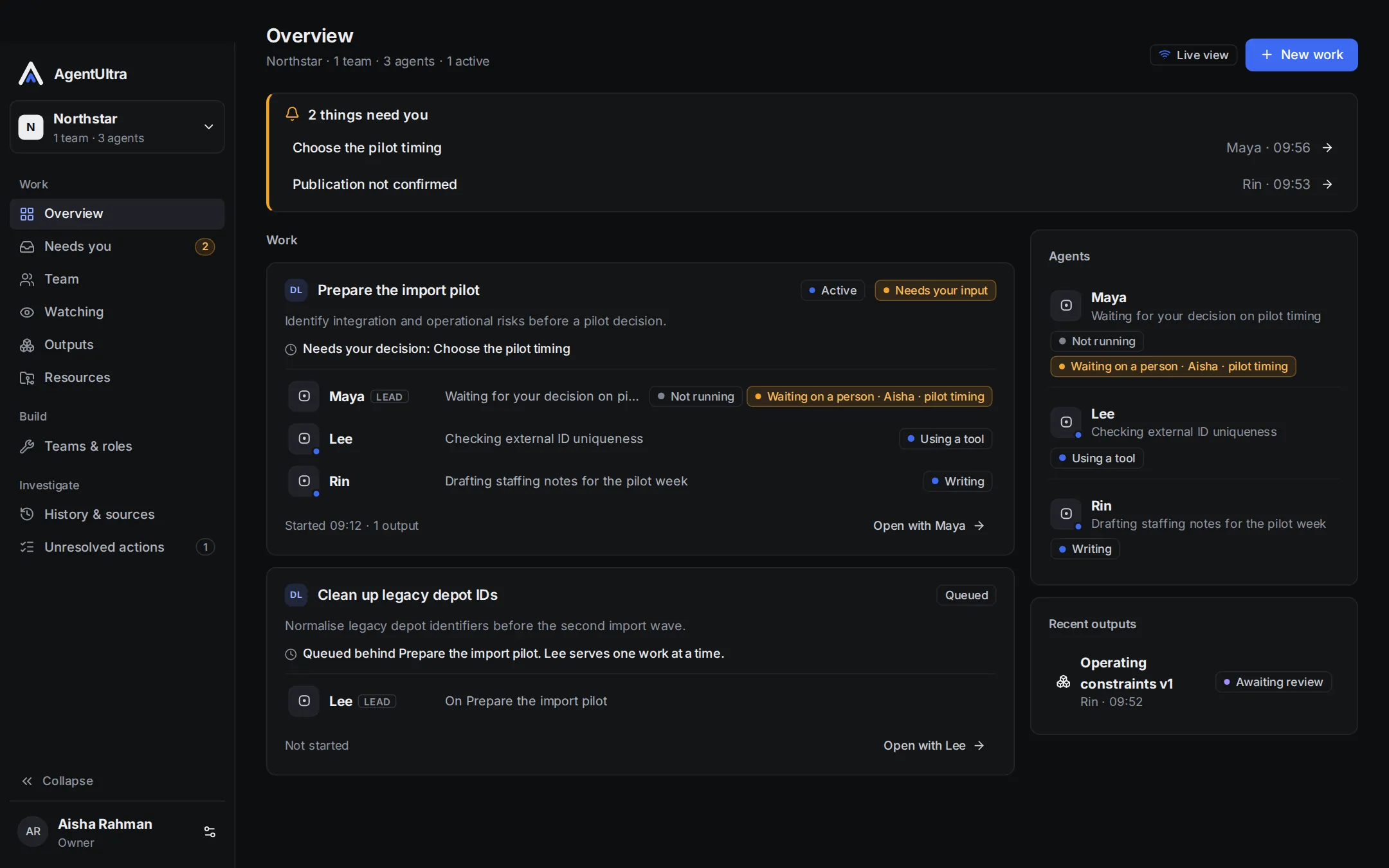
Where every piece of work stands and who is doing what, right now.
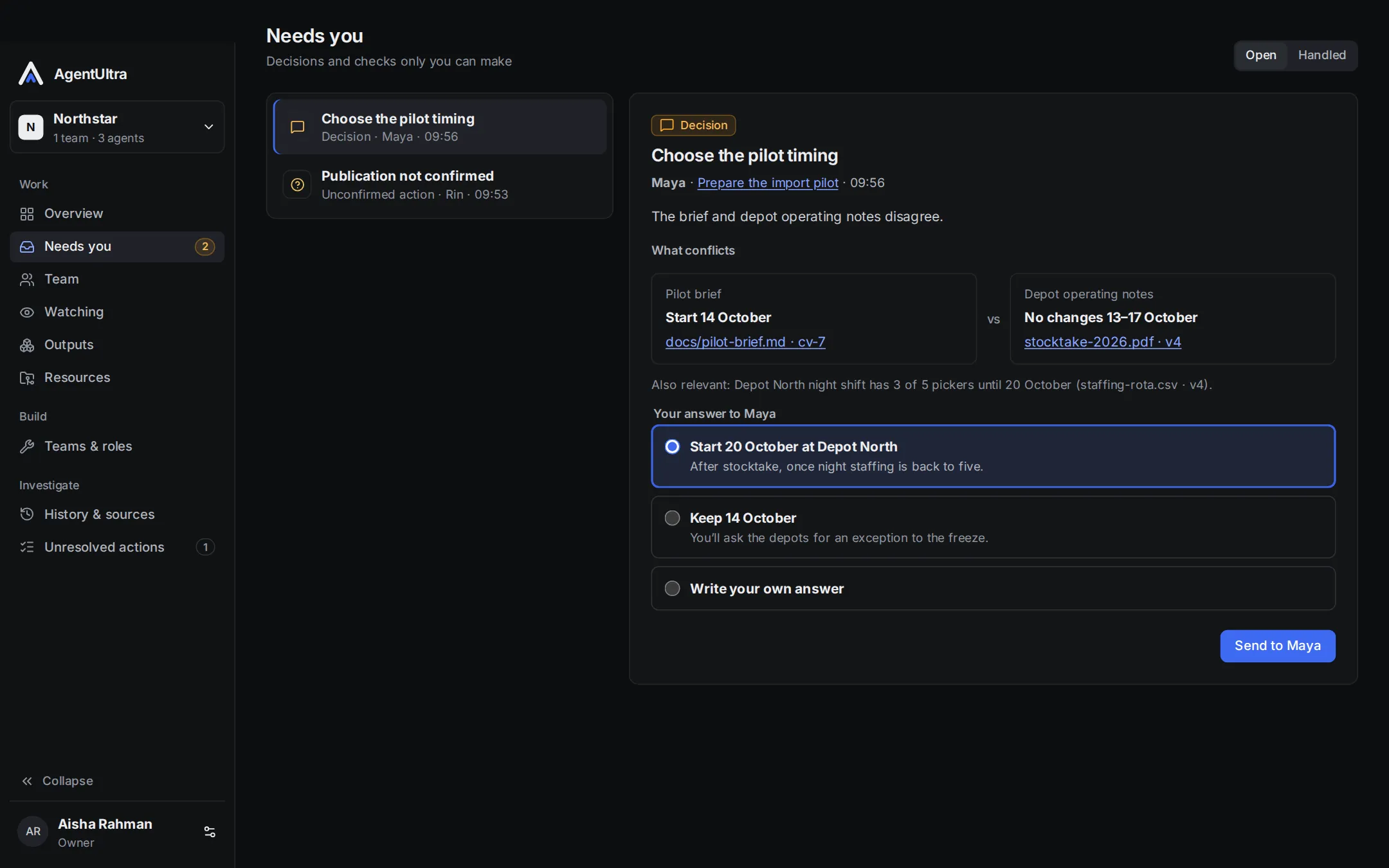
Decisions arrive with the conflict and the exact sources, so you can answer without digging.
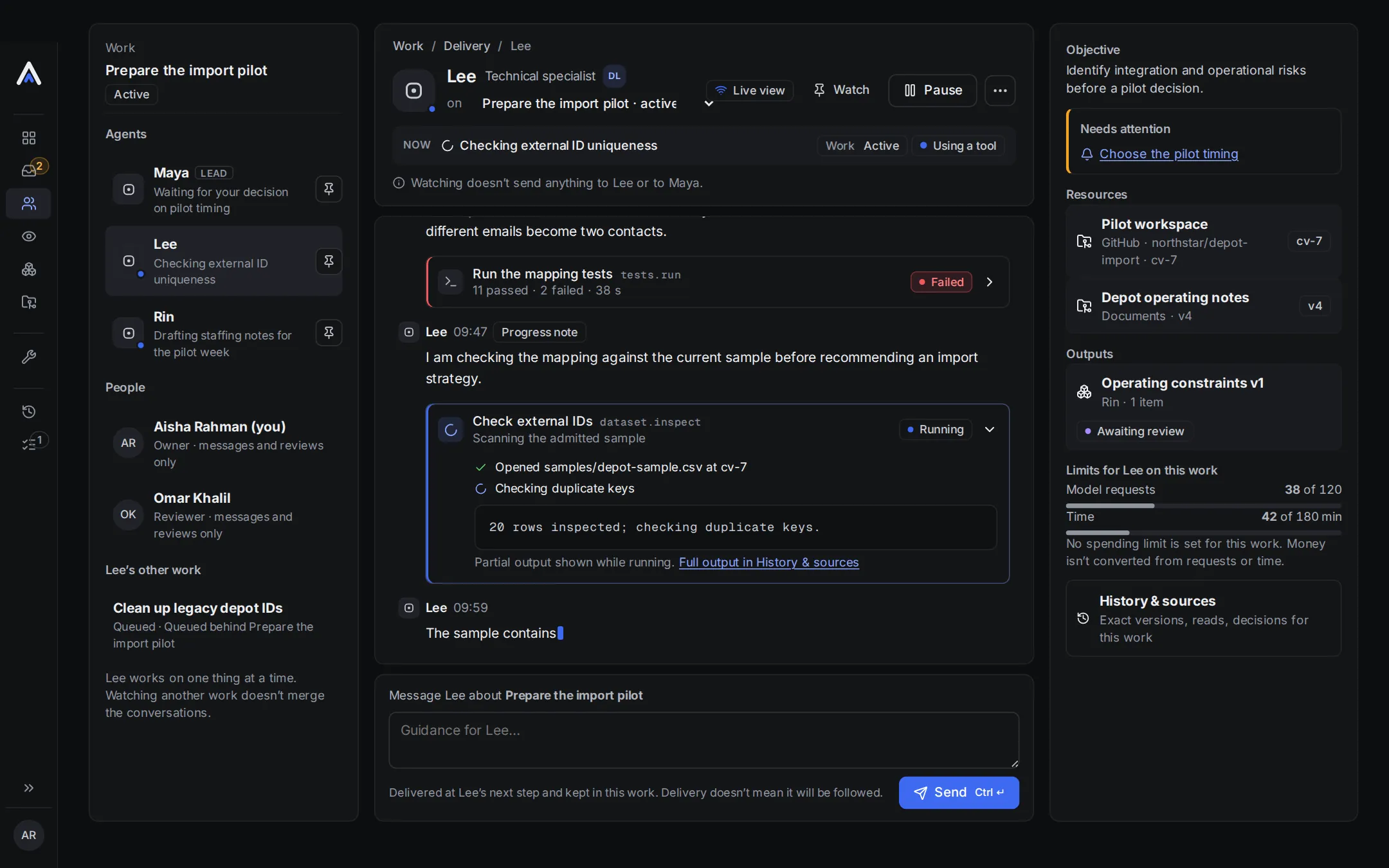
Watch an agent write and use tools live. Watching never sends anything to the agent.
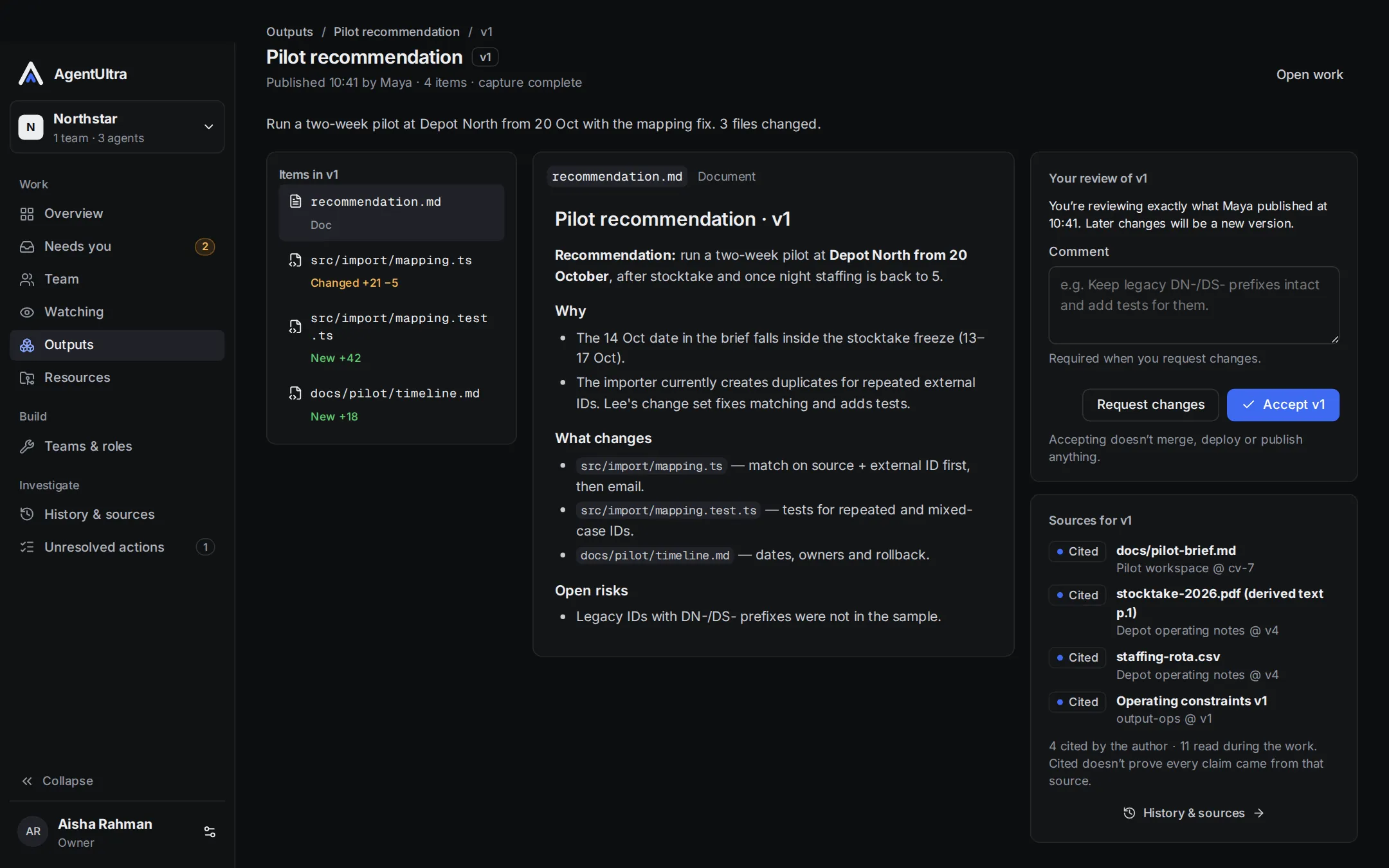
Review v1, request changes, compare v1 to v2, and accept an exact version.
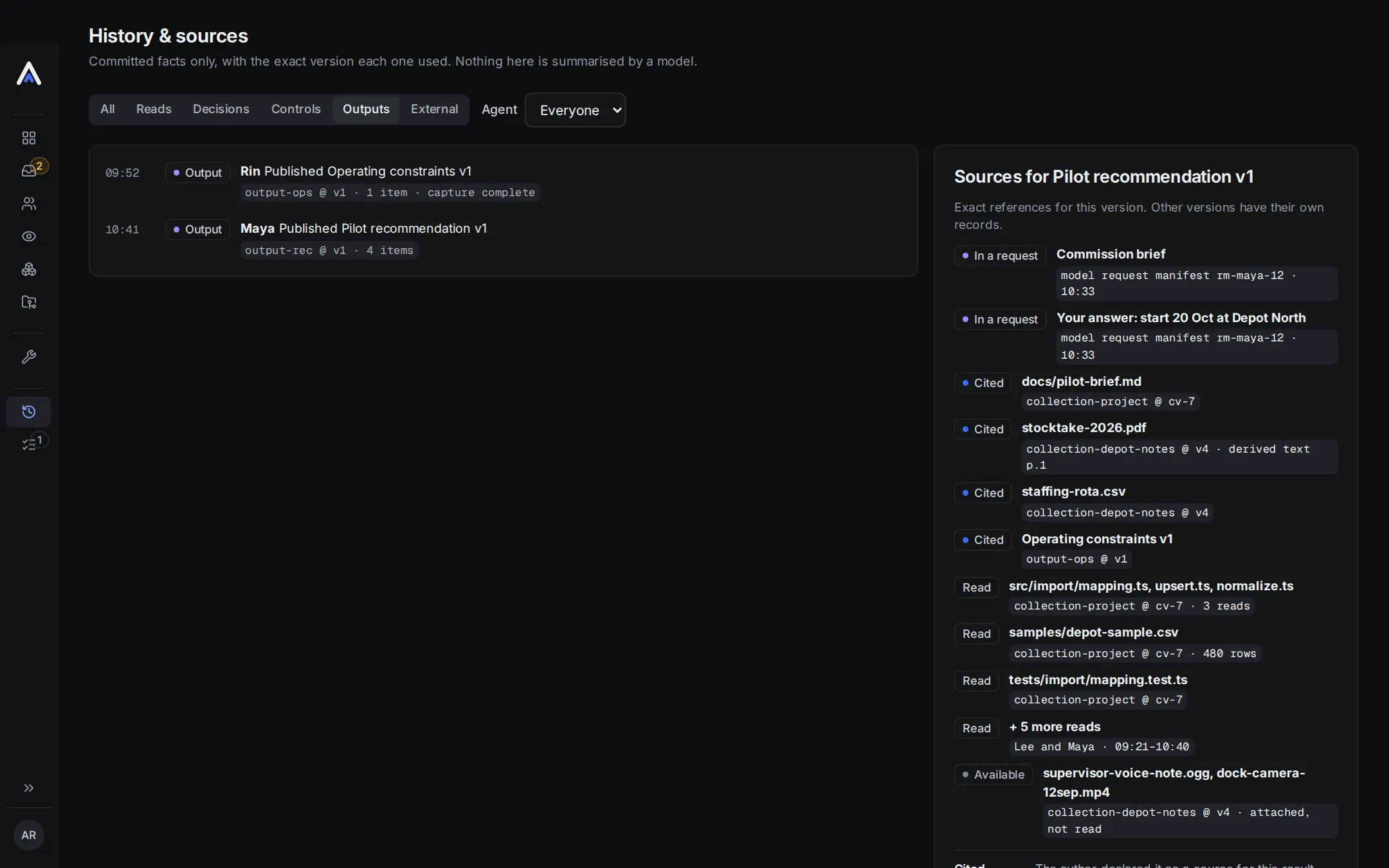
Every output traced to what it cited, read and was reviewed against.
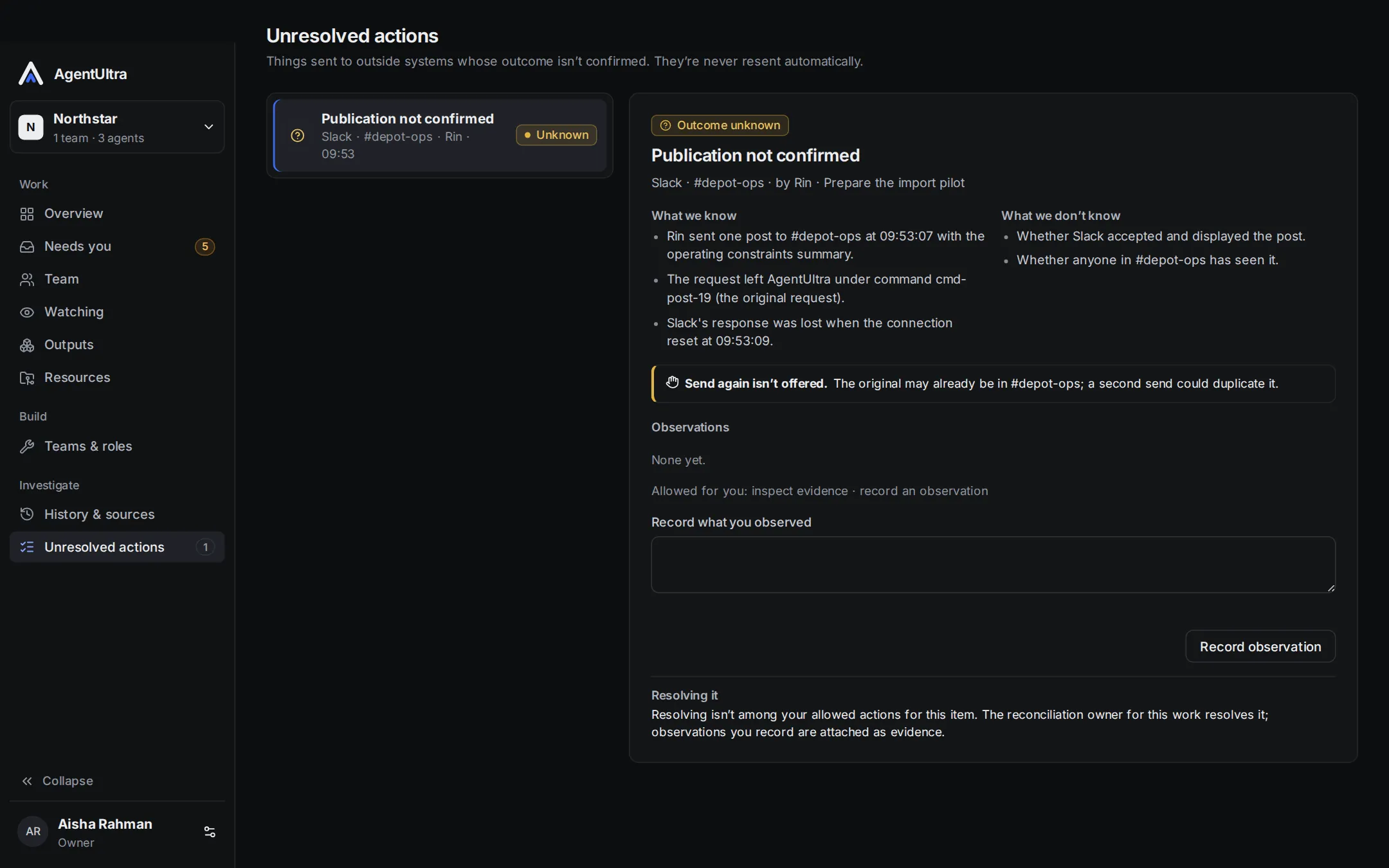
Unconfirmed external actions stay open, with what’s known and what isn’t. There’s no resend button.
Early-access interface design, shown with example data.
Under the hood
Built like infrastructure,
not like a demo.
Control you can defend comes from a transactional core. Agents do the work; the authority decides what counts, what’s allowed and what’s known.
AgentUltra authority
- Ownership & generations
- Policy & admission
- Effect ledger
- Resource accounting
- History & provenance
- Approvals & review
- lease.grantwork=W-2041 owner=agent:analysis gen=8
- write.rejectwork=W-2041 gen=7 reason=stale_generation
- boundary.checkaction=publish policy=v13 → HOLD approval_required
- approval.recordby=dana.r artifact=brief@v3 sha=9f3c…a1 evidence=14
- effect.intentid=eff_7Q2 kind=email.send to=vendor
- effect.outcomeid=eff_7Q2 → UNKNOWN (dispatch lease expired)
- effect.reconcileid=eff_7Q2 → CONFIRMED delivered=1
- work.completework=W-2041 children=terminal released=4
Transactional authority
Ownership, admission, effects and accounting change together or not at all.
Fenced ownership
Leases with generations. Stale owners are refused at commit.
Intent / outcome ledger
Every external effect has an identity. Unknown is a first-class state.
Receipts, not re-runs
History is disclosed from the record. Nothing re-executes to explain itself.
- Teams that report in and take direction.
- Steer the work while it runs.
- Keeps working while you’re away.
- Picks up right where it left off.
- Hand off projects, not prompts.
- Your rules, checked on every step.
- People sign off on what matters.
- Nothing paid or sent twice by accident.
- Budgets that actually hold.
- Every action, on the record.
Built for scrutiny
For work where
“probably” isn’t good enough.
-
Regulated operations
Every action attributable.
Back-office and operations work in regulated industries, where approvals, evidence and outcomes have to stand up to scrutiny later.
-
Software & data
Long migrations, safely.
Cleanups, migrations and investigations that run for days and touch real systems, with fenced ownership and no ambiguous side effects.
-
Research & diligence
Every claim, sourced.
Multi-source analysis where each claim carries its evidence, open questions stay visible, and the final version is the one that was reviewed.
-
Customer operations
People stay accountable.
Queues and conversations run by agent teams, with people deciding what needs judgment and a record of who decided what.
FAQ
Straight answers.
Can’t find yours? Ask it in the early-access form and we’ll answer it personally.
What is AgentUltra?
A platform where teams of AI agents and people do sustained, useful work together. You set up the team: its roles, the tools and information it can use, and the rules it works under. Then you hand it real work, and it keeps going for hours, days or weeks.
While the work runs, AgentUltra keeps track of five things for you, so nobody has to guess:
- Who owns each task. Every task has exactly one agent or person responsible for it at any moment. Two agents never do the same job or overwrite each other, and once work is handed over, the previous owner can’t touch it.
- Who is allowed to do what. Your policy decides what each role may do. AgentUltra checks it at the moment an agent acts, not only when the work was planned, so a change you make applies to the very next step.
- What people signed off on. An approval covers the exact version the person saw. If anything changes afterward, it needs a fresh sign-off.
- Where each result came from. Results carry their sources and the steps behind them, so anyone can see why, not just what.
- What actually happened. Every action that reaches the outside world, like a payment, an email or a change in another system, is tracked until its result is confirmed. If a result is unclear, it’s marked unclear and checked, never quietly retried.
So at any moment you can answer the questions that matter: who is doing what, who allowed it, what was approved, and what really happened.
What kind of work can I hand to an agent team?
Work that’s too big, too long or too important for a single chat. For example:
- Clearing a queue of exceptions before a deadline, with the hard cases routed to the right person.
- Preparing and submitting paperwork across many systems, like prior authorizations or insurance claims.
- A migration, cleanup or investigation that takes weeks and touches real systems.
- Research and due diligence where every claim needs a source.
- A surge of customer requests, worked around the clock.
You set the goal, the rules and who signs off. The team plans the work, splits it up, does it, and brings decisions to the right people with the evidence attached. The In practice section walks through four of these step by step.
How is this different from a chat assistant or a coding agent?
Chat assistants and coding agents are great when one person works on one task in one sitting, checks the answer and decides what to do with it. AgentUltra is for the work that doesn’t fit in that window:
- A team, not one helper. Many agents and people, each with a role, working on the same job at once without stepping on each other.
- Work that outlasts the conversation. It runs for days or weeks and survives crashes, restarts and closed laptops.
- Rules that are enforced, not requested. Limits are checked by the platform at every step, not written into a prompt and hoped for.
- Sign-offs that mean something. An approval is tied to the exact version a person reviewed.
- A record you can stand behind. Every action, decision and outcome is written down as it happens, ready for whoever asks later.
How does AgentUltra stop agents from doing things they shouldn’t?
Most AI tools set limits by asking the model nicely: a line in its instructions that says “never do this.” A model can misread that, lose track of it deep into a long task, or be talked out of it by something it reads. AgentUltra doesn’t depend on the model behaving.
Every action an agent takes, whether reading a record, sending a message, spending budget or changing another system, passes through a checkpoint that AgentUltra controls, outside the model. At that moment it checks your current policy:
- If the action is allowed, it goes ahead and is recorded.
- If it needs a person, it waits for that person to approve the exact version.
- If it isn’t allowed, it doesn’t happen, whatever the model “thinks.” The attempt is recorded too.
Agents can’t raise their own authority. They can only ask for more, and granting it is a decision a person makes, on the record.
How can agents keep working for days or weeks?
In a chat tool, the work lives in the conversation. Close it, or let it run too long, and the thread is gone. In AgentUltra, the work lives in a durable record: the plan, who owns each task, what’s done, what’s waiting and why. Every step is saved as it happens. That changes what’s possible:
- An agent can wait for a person, a document or an outside event without tying anything up. When the answer arrives, the work picks up where it stopped, with its full context.
- A task can move from one agent to another, or to a person and back, without losing its history.
- Time, money and requests are metered across the whole job, not per conversation. When a limit is reached the work stops until someone grants more, so a long job can’t quietly overspend.
- You don’t have to babysit it. Check in whenever you like and you’ll see current progress and anything waiting on you.
What if an agent, a server or my laptop dies in the middle of the work?
The work keeps its place. Here’s what happens in each case:
- You close your laptop or lose your connection. Nothing stops. The work doesn’t run in your browser; it runs on AgentUltra. When you come back you see where things stand, including anything waiting for you.
- An agent crashes or goes silent mid-task. Its hold on the task runs out, and the task goes back to the team with everything done so far. Another agent, or a restarted one, carries on. If the old agent wakes up later, it can no longer act on work it no longer owns, so two agents never write over each other.
- The connection drops during an outside action, like a payment or an email. AgentUltra doesn’t guess, and it doesn’t blindly try again. The action is marked “outcome unknown,” checked with the other system using the action’s own ID, and recorded as it actually turned out. That’s how nothing gets paid or sent twice by accident.
- A server restarts. Each change to the record is saved all at once or not at all, so the record is never left half-updated. Work continues from the last saved step.
- You cancel the work. New steps stop right away. Steps already underway finish or are tracked until their outcome is known, and the job isn’t marked done while anything is still running.
Do people stay in control?
Yes. You decide what agents may do on their own and what needs a person. Sign-off requests arrive with the evidence attached, for the exact version that will go out. You can watch any work as it happens, redirect it, pause it or stop it. Watching never changes anything by accident; only an explicit instruction does. When you pause or stop, you’re told exactly what has stopped and what hasn’t yet. And when you change the rules, the very next action follows the new ones.
How is AgentUltra different from an agent framework?
A framework gives developers parts for building an agent. Everything that makes agents safe to trust with real work is left for your team to build and maintain: who owns which task, what each agent may do and when that’s checked, sign-offs, tracking actions to their results, and a complete history.
AgentUltra is where agent teams actually do the work, with all of that built in. Every agent runs in AgentUltra’s own runner, so the same checks and records apply to every step every agent takes, not only the steps someone remembered to wire up.
When can I use it?
We’re opening early access in stages. Request access below and tell us about the work you’d hand to an agent team. We’ll reach out as places open.
No agent can act on its own.
Every step goes through AgentUltra, is checked against your controls, and leaves an audit-ready trace: every action, decision, input and output.
Early access
Put an agent team
on real work.
Request early access. We’re opening in stages, starting with teams whose work needs these guarantees most.
- Hands-on onboarding with the team building it
- Shape the roadmap with your hardest workflows
- No spam: only messages about early access
AgentUltra · request recorded
You’re on the list.
- Status
- Recorded
- Reference
- —
- Received
- —
- Next
- We’ll email you as early access opens.
Multiplayer AI with receipts.